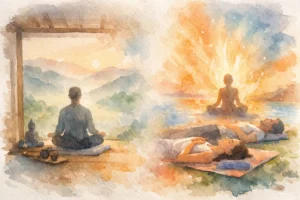
You may return from a retreat feeling wonderfully open, only to find emails, family needs, traffic, and unfinished work waiting for you. That does not mean the retreat failed. It means real life has resumed. Post retreat integration practices are the bridge between a powerful experience and a life that can genuinely hold what you discovered.
A retreat can create rare conditions: time away from familiar roles, nourishing food, fewer decisions, intentional community, and space to feel what daily momentum can keep buried. Breathwork may bring insight, emotion, release, quiet, or a new intimacy with yourself. Yet insight alone does not change a pattern. Integration is the gentle, ongoing practice of giving your nervous system, body, and choices time to catch up with what your heart already knows.
Why the days after a retreat matter
Many people expect to come home transformed in a way that is obvious and permanent. Sometimes there is an initial glow. Sometimes the return is tender, disorienting, or unexpectedly emotional. Both responses can be part of the process.
A meaningful retreat can loosen an old identity, reveal the cost of a habit, or make a long-silenced truth impossible to ignore. Returning immediately to the same pace may feel jarring because your system is still processing. Rather than judging that sensitivity, meet it with respect. You do not need to recreate the retreat at home. You need to create enough steadiness to listen to what is still unfolding.
Integration also protects against a common trap in transformational spaces: chasing the next peak experience while avoiding the quieter work of change. The deepest shift is often less dramatic. It may look like pausing before a familiar reaction, asking for support, taking a full breath before saying yes, or choosing rest without defending it.
Post retreat integration practices for the first week
The first seven days are not a test of your discipline. They are an invitation to reduce unnecessary pressure and stay close to yourself. If you can, leave some breathing room around your return rather than scheduling a demanding social calendar or making major decisions the next morning.
Let the body set the pace
Your body has its own language after deep inner work. You may feel energized, tired, sensitive, spacious, or all of these in one day. Prioritize the foundations: sleep, regular meals, water, daylight, gentle movement, and moments without screens or stimulation.
This is not about being precious or withdrawing from responsibility. It is about recognizing that regulation is physical. A settled body gives insight somewhere to land. If strong emotions, panic, dissociation, or memories feel difficult to manage, seek appropriate support from a qualified mental health professional or an experienced, trauma-informed practitioner. Retreat integration is not meant to be done alone when more care is needed.
Keep your breathwork simple
A long, intense session is not always the wisest response to a profound retreat experience. For some people, especially after emotionally charged work, short and orienting practices are more supportive than trying to force another breakthrough.
Try sitting with one hand on your chest and one on your belly for five minutes. Feel the ground beneath you. Let your exhale lengthen naturally, without strain. Notice three things you can see, three sounds you can hear, and one sensation in your body. The purpose is not to manufacture a particular state. It is to remind your system that presence is available here, in an ordinary Tuesday afternoon.
Your retreat facilitator may have offered specific guidance, and that should take priority. Breathwork is not one-size-fits-all. The right rhythm depends on your experience, your nervous system, your health, and what arose during the retreat.
Write before the insight becomes a slogan
Within a few days, make time to journal without trying to turn your experience into a polished story. Begin with simple prompts: What surprised me? What feels more true now? What am I grieving? What am I no longer willing to abandon in myself?
Then ask a more practical question: What is one small behavior that would honor this realization? If you recognized that your pace has become unsustainable, the action might be one phone-free lunch break each week. If you felt the need for more honest connection, it might be sending one message you have been avoiding. Small actions are not less spiritual. They are how devotion becomes visible.
Turn insight into an environment
Willpower is a fragile container for change. Your environment, calendar, relationships, and routines will either reinforce what you learned or pull you back toward autopilot. This is where integration becomes tangible.
Choose one ritual that has a clear beginning and end. It could be ten minutes of conscious breathing before work, a weekly walk without headphones, or a Sunday check-in with a journal. Make it small enough that you can keep it during a difficult week. Consistency builds trust with yourself far more effectively than an ambitious routine that disappears after four days.
It can also help to name one boundary that supports your return. Perhaps you delay nonessential commitments for two weeks, step back from conversations that leave you depleted, or stop checking your phone in bed. A boundary is not a punishment. It is a structure that gives a new choice the chance to become familiar.
Share carefully, not urgently
After a retreat, it is natural to want to tell everyone what happened. But not every person in your life will understand the language of transformation, and not every insight needs immediate feedback. Sharing too soon can sometimes make an experience feel smaller, especially if someone responds with skepticism, advice, or a quick attempt to explain it away.
Choose one or two people who can listen without trying to fix you. You might say, “I do not need an answer. I just want to share something that matters to me.” This creates a more honest kind of support.
Community from the retreat can be valuable too. A brief check-in with someone who shared the space may remind you that you did not imagine the depth of what you felt. At the same time, notice whether repeated processing is helping you move forward or keeping you attached to the intensity of the experience. Integration includes returning to your own authority.
Watch for the urge to make your whole life different overnight
A retreat may make it clear that a relationship, job, habit, or living situation needs attention. That clarity deserves respect. But immediate, sweeping decisions are not always the same as embodied wisdom.
Give yourself enough time to distinguish a passing emotional wave from a grounded inner knowing. There are exceptions, of course. If a situation is unsafe or harmful, seeking support and taking action should not be delayed. In most cases, though, let the insight meet your daily reality through patient observation. What remains true after you have slept, eaten, worked, and had a hard day? That is often where the deeper guidance lives.
Create a 30-day integration rhythm
The real test of post retreat integration practices is not whether you maintain a perfect routine. It is whether you know how to return when life interrupts you. A 30-day rhythm can offer enough structure without becoming another project to succeed at.
Set aside one weekly hour for reflection. Revisit your journal, notice patterns in your mood and energy, and ask what support would serve you now. Keep one breath-centered practice that feels regulating rather than performative. Choose one courageous action each week that aligns with what you learned, whether that means a conversation, a boundary, a rest day, or a creative step you have delayed.
If you want to deepen your relationship with breathwork, ongoing guided practice can provide a supportive container after the retreat ends. At Alchemy of Breath, the emphasis is not on collecting extraordinary experiences. It is on learning to meet your life with more awareness, compassion, and capacity, one breath at a time.
You do not have to prove that your retreat changed you. Let change become quiet, kind, and practical. Let it appear in the moment you soften your shoulders, tell the truth with care, or remember that you can come home to your breath even when the world is asking a lot of you.