A powerful retreat is rarely about escaping your life for a few beautiful days. It is about meeting yourself with enough time, safety, and support that something real can begin to shift. Small group healing retreats create the conditions for this kind of encounter: fewer distractions, more personal attention, and a circle where your nervous system does not have to work so hard to stay guarded.
For many people, life has become a long practice in holding it together. You may be functioning, caring for others, achieving, and still carrying anxiety, grief, exhaustion, or a quiet sense that you have drifted away from yourself. A retreat cannot erase the complexity of a life. But it can offer a meaningful interruption – a chance to breathe, feel, listen, and remember what is true beneath the noise.
Why Small Group Healing Retreats Feel Different
The size of a group changes the quality of the experience. In a large room, it can be easy to disappear, compare yourself with others, or feel that your process has to fit a predetermined pace. In a smaller group, facilitators can better respond to what is actually happening in the space. There is greater opportunity to be seen, to ask for support, and to take part without performing your healing.
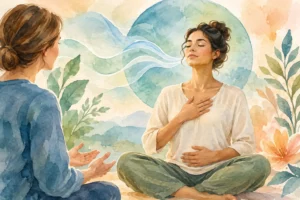
This matters especially when a retreat includes breathwork. Conscious connected breathing can bring emotion, memory, sensation, and insight closer to the surface. It can be deeply liberating, but it is not simply a high-energy experience to push through. The quality of facilitation, pacing, consent, and integration all matter. A smaller setting can make it easier for participants to receive grounded guidance and for the group field to remain personal rather than anonymous.
There is also a particular kind of medicine in being witnessed by people who are not trying to fix you. When the space is held with compassion, another person naming a familiar fear or longing can soften the belief that you are alone in yours. Connection does not replace inner work. It gives inner work somewhere safe to land.
Healing Is Not Always Dramatic
People sometimes arrive at a retreat hoping for one life-changing breakthrough. Those moments can happen. A deep breathwork session may bring clarity about a relationship, release long-held tears, or reconnect you with a sense of purpose that felt out of reach.
Yet quieter shifts are just as valuable. You may notice that your shoulders lower without being told to relax. You may sleep more deeply after several nights away from constant demands. You may realize that the inner voice you thought was permanent becomes less convincing when your body is nourished, your breath is moving, and there is room for silence.
Real transformation is often less about becoming someone new and more about returning to the parts of yourself that had to go quiet. The goal is not to manufacture a peak state. It is to create enough presence that your own intelligence, tenderness, and capacity for choice can come forward.
What a Well-Held Retreat Container Includes
Not every retreat is designed with the same depth or care. A beautiful destination and an inspiring schedule may be appealing, but the container matters more than the scenery. Before choosing a retreat, look for clear information about who is facilitating, how participants are supported, and what happens after an intense session.
A strong healing retreat usually balances structured practice with spaciousness. There may be guided breathwork, meditation, movement, reflection, rest, and group sharing. But there should also be permission to slow down. Constant activity can keep the mind busy while the deeper material waits in the background.
Trauma-informed practice is particularly important. This does not mean a retreat promises to treat trauma or replace therapy. It means facilitators understand that people have different histories, thresholds, and responses. They offer choice rather than pressure, encourage participants to work within their capacity, and avoid presenting emotional intensity as proof that healing has occurred.
Breathwork as a Doorway to Regulation
Breathwork can be a powerful part of a retreat because breath is both immediate and intimate. It meets you where you are. You do not need to explain every feeling before you begin. By changing the rhythm and quality of your breathing, you may begin to notice the patterns your body has been repeating beneath conscious awareness.
Some practices support settling and regulation. Others invite a more expansive emotional process. Both have value, and neither is automatically right for every person at every moment. Skilled facilitation helps participants understand the difference between stretching their edge and overriding their system.
At Alchemy of Breath, breathwork is approached as an embodied path of transformation, not a one-size-fits-all technique. The intention is not to chase catharsis. It is to build a more honest relationship with the body, the breath, and the life asking to be lived.
The Group Is Part of the Practice
In small group healing retreats, community is not an extra feature. It is part of the work. Being in a circle asks something different of us than private self-help does. We practice receiving. We practice speaking from what is real rather than what sounds polished. We practice allowing others to have their own experiences without making them responsible for ours.
This can be challenging at first, especially for those who are used to being the capable one. But a well-facilitated group does not demand disclosure. It invites authenticity at a pace that feels respectful. Sometimes the most honest thing you can say is, “I do not know what I am feeling yet.” That is still a beginning.
The bonds formed on retreat can be surprisingly meaningful because they are rooted in presence rather than social performance. Still, it helps to keep expectations grounded. You do not need to leave with lifelong friends for the retreat to matter. A single conversation that helps you feel less ashamed, more understood, or more willing to ask for help can stay with you for years.
Choosing the Right Retreat for This Season of Your Life
The best retreat is not necessarily the most intense one. It is the one that meets your actual needs. If you are depleted, a schedule built around nonstop activation may not be supportive. If you are new to breathwork, look for a program that welcomes beginners and clearly explains how sessions are guided. If you are a coach, therapist, yoga teacher, or wellness practitioner, you may want an experience that includes both personal transformation and a deeper understanding of responsible facilitation.
Consider what you need from the environment as well. Some people are nourished by nature, quiet mornings, and unhurried meals. Others need a more structured program to feel secure enough to let go. Ask whether the retreat makes space for integration, not only insight. The real question is not, “How much can I experience?” It is, “What can I receive and carry back into my life?”
If you are currently navigating acute mental health challenges, serious medical concerns, or recent trauma, speak with an appropriate licensed healthcare professional before joining an intensive breathwork retreat. Honest preparation is an act of self-respect, not a limitation.
Bringing the Retreat Home With You
The return home is where the retreat begins to reveal its value. Your inbox may still be full. Your family may still need you. The patterns that shaped your life will not disappear because you spent a weekend breathing deeply in a supportive circle.
But you may return with a new pause between stimulus and reaction. You may recognize the first signs of overwhelm sooner. You may remember that your breath is available before the spiral gains momentum. These are not small things. They are the building blocks of a more regulated, intentional life.
Integration does not need to be elaborate. A few minutes of conscious breathing in the morning, a journal note when an old pattern appears, a walk without your phone, or a commitment to ask for support can honor what opened during the retreat. The point is not to preserve a retreat feeling. It is to let the truth you touched become useful in ordinary moments.
The right small group retreat does not ask you to leave your life behind. It helps you return to it with more breath, more choice, and a deeper trust that healing can happen one honest moment at a time.